
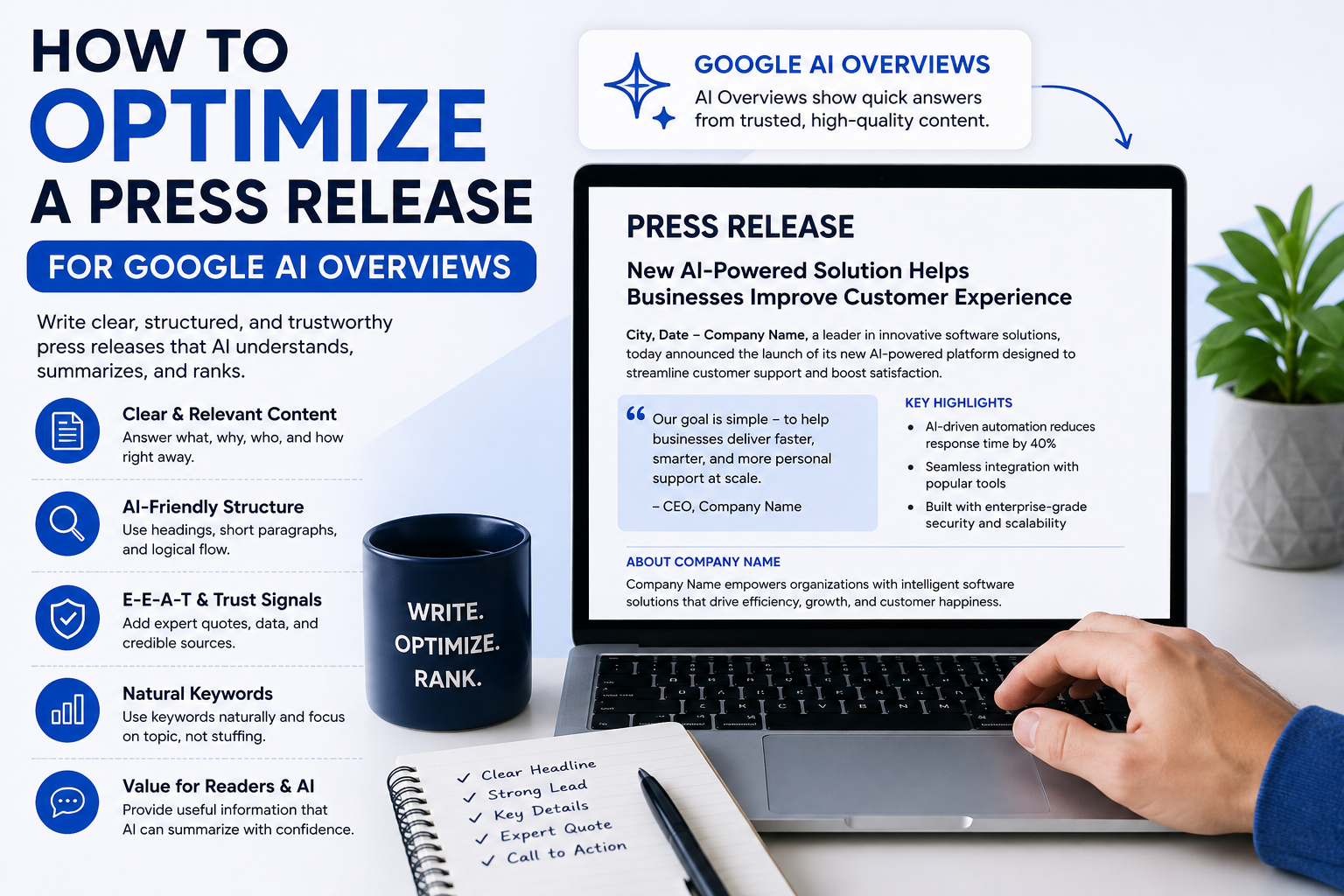
How to Optimize a Press Release for Google AI Overviews
To optimize a press release for Google AI Overviews, you need to write for both humans and AI-driven search systems. Clear structure, direct answers, natural keywords, credible information, and conversational writing all improve your chances of appearing in AI-generated summaries. Press releases that focus on clarity instead of promotion usually perform better in modern search results.
Press releases used to follow a predictable formula. Big headline. Corporate statement. Generic quotes. A few promotional claims. Then publish and hope journalists notice.
That approach doesn’t work nearly as well anymore.
Search behavior has changed fast, and Google AI Overviews are a big reason why. Instead of simply listing web pages, search engines now summarize information directly inside search results. That means your press release has to be easy for AI systems to understand, interpret, and quote accurately.
If you’re trying to figure out how to optimize a press release for Google AI Overviews, here’s the truth: keyword stuffing and robotic writing won’t help you. Clear communication will.
I’ve seen relatively unknown brands earn impressive visibility simply because their announcements were structured better than competitors with much larger budgets. In most cases, the difference wasn’t authority alone. It was readability and informational depth.
Modern press releases need to do more than announce news. They need to answer questions immediately, establish trust quickly, and provide context AI systems can summarize confidently.
That changes everything.
What Is Press Release Optimization for Google AI Overviews?
Press Release Optimization for Google AI Overviews — The process of structuring and writing press releases so AI-powered search systems can easily understand, summarize, and display the content in search results.
Google AI Overviews aim to provide fast answers to users. Instead of forcing people to open multiple pages, the system extracts useful information and presents summarized responses directly inside search results.
Your press release can become part of those summaries if it meets certain quality signals.
Typically, AI-friendly press releases include:
- Clear topic relevance
- Strong informational structure
- Direct answers early in the content
- Natural keyword usage
- Expert-backed details
- Readable formatting
- Contextual depth
Here’s what many businesses still misunderstand: AI systems don’t just scan for keywords anymore. They evaluate whether content genuinely helps explain a topic.
That means a press release overloaded with marketing language often performs worse than one written in simple, informative language.
Honestly, some old-school press releases sound like they were written by committee. Everything feels polished but empty. AI systems are getting surprisingly good at recognizing that kind of fluff.
And readers notice it too.
Why AI Overviews are changing press release SEO
Traditional SEO mostly focused on ranking pages.
AI search changes the goal slightly. Now your content also needs to become “extractable.” In other words, search systems should be able to pull meaningful summaries from your content without confusion.
That requires:
- clearer writing
- logical organization
- concise explanations
- topic consistency
Press releases that ramble or hide important details deep in the article usually struggle.
Human-first writing matters more than ever
This is probably the most overlooked shift.
A press release written naturally often performs better than one designed purely for search engines. AI systems increasingly reward content that sounds human because humans engage with it more effectively.
That’s not an accident.
Google wants search results that satisfy users quickly. If your content feels awkward or difficult to read, it becomes less useful for AI-generated summaries.
Why Optimizing Press Releases Matters in 2026
Search engines are becoming answer engines.
That’s the simplest way to describe what’s happening.
Users now expect immediate information without digging through multiple websites. AI Overviews attempt to satisfy that expectation by summarizing content directly in search.
If your press release isn’t optimized for that environment, visibility becomes harder to maintain.
AI-generated search results reduce traditional clicks
This part makes some marketers uncomfortable.
In many cases, users now get enough information directly from search results without clicking a website at all. That means your press release must communicate authority instantly.
A weak summary opportunity can reduce exposure dramatically.
On the other hand, appearing in AI summaries can place your brand in front of thousands of highly targeted users.
Brand authority now depends on clarity
Years ago, brands could hide behind polished corporate language.
Not anymore.
AI systems prioritize useful information over vague promotional statements. Clear communication has become a trust signal.
For example:
Weak statement:
“Our company continues leading innovative transformation globally.”
Stronger statement:
“Our platform reduced customer support wait times by 42% during beta testing.”
One sounds generic. One sounds credible.
That difference matters to both readers and algorithms.
Fresh content helps AI visibility
Google AI systems favor updated and relevant information. Press releases naturally support freshness because they introduce new announcements, updates, partnerships, and data points.
That’s one reason optimized press releases can still support SEO effectively in 2026.
They generate:
- fresh indexed content
- new topical relevance
- brand mentions
- engagement opportunities
- authority signals
But only when written properly.
Expert Tip
Many companies overcomplicate AI optimization. In reality, readability and informational usefulness usually matter more than “advanced SEO tricks.”
How to Optimize a Press Release for Google AI Overviews — Step by Step
1. Write a headline that explains the story immediately
Your headline should communicate the core announcement clearly.
Avoid vague corporate language.
Bad example:
“Redefining the Future of Digital Innovation”
Better example:
“How a New Customer Service Platform Cuts Support Response Times”
Specific headlines help AI systems identify the topic instantly.
They also improve click-through rates because users understand the value immediately.
Here’s the thing: clever headlines often underperform because they create ambiguity. AI systems prefer clarity over creativity most of the time.
Include your primary keyword naturally
Your primary keyword should appear inside the headline without sounding forced.
For this topic, examples could include:
- optimize a press release for Google AI Overviews
- AI-friendly press release strategy
- press release SEO optimization
Natural phrasing matters.
Over-optimized headlines feel awkward fast.
2. Use the introduction to answer core questions
Your opening paragraph is extremely important.
AI systems often pull introductory information when generating summaries, so your first 100 words should explain:
- what happened
- who is involved
- why it matters
- who benefits
Don’t make readers search for the point.
I’ve reviewed press releases where the actual announcement didn’t appear until paragraph four. That’s a visibility killer now.
Keep introductions concise but informative
A strong introduction balances brevity and depth.
For example:
“A cybersecurity company launched a new AI-driven threat monitoring system designed to reduce detection time for enterprise security teams.”
Clear. Direct. Informative.
No unnecessary hype.
3. Structure content with clear H2 headings
AI systems understand organized content better.
That’s why section headings matter more than many people realize.
Use headings that reflect real user questions:
- What does the product do?
- Why does this update matter?
- How does the technology work?
- Who benefits most?
Question-based headings improve both readability and AI extraction potential.
Avoid giant text blocks
Large paragraphs reduce readability.
Keep sections digestible:
- shorter paragraphs
- concise explanations
- logical flow
- direct language
Honestly, readability is probably one of the most underrated SEO advantages right now.
4. Add supporting details and real context
Thin press releases rarely perform well in AI search environments.
You need substance.
Include details like:
- measurable results
- launch timelines
- customer impact
- industry relevance
- market context
- expert insights
Specific information helps AI systems determine credibility.
Compare these two examples:
Weak:
“Our software improves business efficiency.”
Stronger:
“Beta users reduced internal reporting time from six hours to under ninety minutes.”
Specificity builds trust quickly.
Mini case study example
A SaaS company announced a workflow automation update but initially published a generic release with almost no context.
Performance was poor.
Later, they updated the release with:
- implementation statistics
- customer use cases
- practical examples
- clearer explanations
Search visibility improved noticeably within weeks.
No fancy trick involved.
Just more useful information.
Expert Tip
If your press release could apply to almost any company in your industry, it’s probably too generic.
5. Use natural keyword placement
Keyword optimization still matters. Just differently now.
Instead of repeating the same phrase unnaturally, focus on semantic relevance and topic completeness.
For example, alongside your primary keyword, related phrases might include:
- AI search optimization
- answer engine optimization
- AI-generated summaries
- press release SEO
- search visibility
- AI-friendly content
Use them naturally inside relevant sections.
Avoid over-optimization
This is where many brands go wrong.
Repeating the same phrase excessively hurts readability and can make content feel manipulative.
In my experience, modern AI systems respond better to natural topical coverage than forced repetition.
That’s actually good news for writers because content becomes easier to read.
6. Include human-sounding quotes
Executive quotes still matter, but they need to sound authentic.
Bad quote:
“We are honored to continue leading innovation excellence.”
Nobody talks like that.
Better quote:
“We realized customers were wasting too much time on repetitive onboarding tasks, so we focused on simplifying the process.”
That sounds believable.
AI systems increasingly favor conversational clarity because it reflects genuine human communication.
Why quotes matter for AI summaries
Quotes add:
- expertise
- emotional context
- credibility
- perspective
They also break up content naturally.
A press release without quotes often feels flat and mechanical.
Common Mistakes That Hurt AI Overview Visibility
Most poorly performing press releases share similar problems.
Too much promotional language
AI systems prioritize useful information, not exaggerated claims.
Phrases like:
- industry-leading
- revolutionary
- best-in-class
- unmatched innovation
usually add very little value unless supported by evidence.
Hiding important information
Some press releases spend half the article building suspense before explaining the announcement.
That strategy doesn’t work well anymore.
Search systems want immediate clarity.
Writing for algorithms instead of readers
Ironically, the best AI optimization strategy often involves focusing more on human readability.
That’s because AI systems increasingly model human engagement patterns.
If content feels confusing, bloated, or unnatural, both readers and algorithms respond poorly.
Counterintuitive reality
Longer press releases can sometimes perform better than short ones.
That surprises many marketers.
But detailed content often provides more context for AI systems to interpret accurately.
The key is meaningful depth — not filler.
What Actually Works for AI-Friendly Press Releases
After watching SEO evolve for years, one thing stands out clearly:
Useful content consistently outperforms empty promotion.
Clarity beats cleverness
Simple writing usually wins.
That doesn’t mean boring writing. It means understandable writing.
Readers appreciate direct communication. AI systems do too.
Use real examples whenever possible
Realistic examples increase trust dramatically.
For instance:
“Early pilot users reduced customer onboarding time by 37%.”
That statement carries weight because it sounds measurable and practical.
Explain why the news matters
Many press releases announce updates without explaining their impact.
That’s a mistake.
Readers — and AI systems — care about significance.
Why should anyone care about this announcement?
Answer that clearly.
Personal hot take
Honestly, I think traditional PR writing created a lot of bad habits. Many companies still confuse “professional” with “overly formal.”
Modern AI search rewards communication that sounds informed but human.
That’s a major shift.
Expert Tip
Read your press release aloud before publishing it. If parts sound stiff or robotic in conversation, rewrite them.
How AI Systems Evaluate Press Release Authority
Google AI systems attempt to measure trustworthiness using multiple signals.
That includes:
- factual consistency
- source credibility
- topical relevance
- readability
- contextual completeness
Press releases lacking depth or clarity may struggle to appear in AI summaries.
Topical authority matters
Brands publishing consistent, informative content around specific topics often gain stronger visibility.
For example, a cybersecurity company consistently publishing:
- threat analysis
- security updates
- industry reports
- technical announcements
builds stronger topical relevance over time.
AI systems notice those patterns.
Freshness and recency still matter
Updated announcements help reinforce relevance.
That’s why timely press releases can support broader SEO performance when connected to meaningful news.
But publishing low-quality announcements constantly usually doesn’t help much.
Quality matters more than volume.
Why Conversational Writing Improves AI Optimization
Conversational writing improves comprehension.
That sounds simple because it is.
Readers process natural language faster than stiff corporate phrasing. AI systems increasingly mirror those engagement preferences.
Conversational doesn’t mean casual
You can still sound authoritative while writing naturally.
For example:
Formal:
“The organization remains committed to operational advancement.”
Natural:
“We wanted to make the process faster and less frustrating for customers.”
The second example feels clearer instantly.
Human phrasing improves snippet potential
AI-generated summaries often pull concise, understandable statements directly from content.
That means natural explanations have a better chance of appearing in summaries.
Awkward jargon rarely survives extraction cleanly.
People Most Asked About Google AI Overviews and Press Releases
How do Google AI Overviews choose press release content?
AI Overviews usually prioritize content that is clear, trustworthy, informative, and easy to summarize. Structured formatting and direct answers improve visibility potential.
Can press releases appear in AI-generated summaries?
Yes. Press releases with strong topical relevance, clear explanations, and useful supporting details can appear in AI-generated search summaries.
How long should an AI-optimized press release be?
There’s no perfect length, but depth matters. In most cases, detailed and informative press releases perform better than extremely short announcements.
Do keywords still matter for press release SEO?
Yes, but natural usage matters far more now. AI systems evaluate context and semantic relevance instead of simple keyword repetition.
Should press releases sound conversational?
Usually yes. Conversational writing improves readability and helps AI systems interpret information more accurately.
What type of headlines work best for AI Overviews?
Specific headlines that clearly explain the topic tend to perform best. Avoid vague or overly promotional wording.
Are backlinks still useful for press releases?
Backlinks still support authority and visibility, although content quality and contextual usefulness now play a larger role in AI-driven search environments.
How often should brands publish optimized press releases?
Publish when you have meaningful news or updates. Consistent quality matters more than excessive frequency.
AI-driven search systems reward content that answers questions quickly, explains ideas naturally, and provides real informational value. Brands that adapt to this shift will probably gain stronger visibility over time.
Meanwhile, companies still relying on bloated corporate language may struggle to stay visible in modern search results.
And honestly, that’s probably a positive change overall. Better communication creates better experiences for readers too.

Alex Jord
Leave a comment
Your email address will not be published. Required fields are marked *