


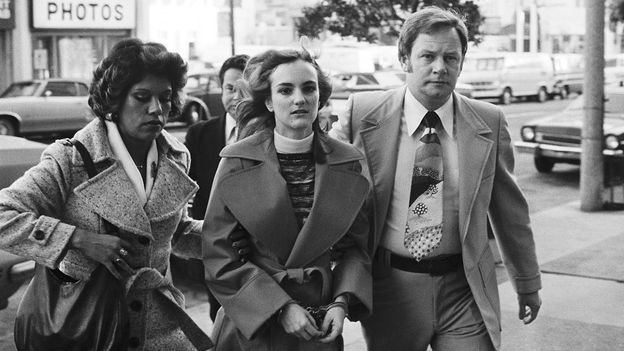
In February 1974, Patty Hearst, a 19-year-old undergraduate and heir to a newspaper fortune, was abducted from her Berkeley, California, apartment. Her kidnapping was executed by the Symbionese Liberation Army (SLA), a radical group that sought to challenge the capitalist structures of society. Just over a week after her abduction, a tape recording of Hearst confirmed she was alive, delivering a chilling message to her family: "Mom, Dad, I'm with a combat unit that's armed with automatic weapons." This incident was not just a kidnapping; it was a complex interplay of high society, psychological trauma, and radical violence that captivated the American public.
The media frenzy surrounding Hearst's case rivaled that of the Watergate scandal, with her plight becoming a focus of national attention. The situation took a dramatic turn when she was seen on surveillance footage participating in a bank robbery, wielding a machine gun, a shocking development that sparked debates about whether she had been brainwashed or was a willing participant in the SLA's activities.
The SLA, an obscure far-left group, was notorious for its violent tactics, including the murder of Oakland school superintendent Marcus Foster. Hearst's abduction was seen as a symbolic act against a wealthy family that embodied the capitalist society the SLA sought to dismantle. As John Humphrys, a journalist covering the case, noted, the SLA members were prepared to commit murder for their cause.
In the days following her kidnapping, the SLA issued demands for a $2 million food distribution program for the poor in California, using Hearst as leverage. SLA leader Donald "Cinque" DeFreeze threatened to execute Hearst if their demands were not met, stating that he was willing to sacrifice her life for those of starving individuals. Hearst, in a subsequent tape, expressed that her captors were "not just a bunch of nuts" and claimed they were "perfectly willing to die for what they're doing." This strange alliance between Hearst and her kidnappers raised questions about her psychological state.
Food Distribution and Public Response
The Hearst family eventually agreed to the SLA's demands, leading to what was described as the most bizarre ransom ever paid. Distribution points for food aid were established in impoverished neighborhoods, where chaotic scenes unfolded as crowds clamored for provisions. Some recipients rejected the aid, disapproving of the SLA's violent methods. Hearst herself later criticized the quality of the food provided, describing it as a "real disaster" and expressing doubt about her captors' motives.
Transformation from Victim to Fugitive
By April 1974, Hearst made a dramatic declaration on tape: she had chosen to join the SLA in their fight for freedom. This revelation shocked her family and the public, leading her father to express disbelief that she could change her philosophies so rapidly. Hearst's mother echoed this sentiment, asserting that her daughter would never willingly join such a group without coercion.
On April 15, 1974, Hearst was implicated in a bank robbery, marking her transformation from victim to fugitive. In a subsequent tape, she rejected the idea of being brainwashed, asserting her commitment to the SLA and denouncing her former life. This shift in identity was further complicated by the SLA's relocation to Compton, Los Angeles, where a deadly confrontation with law enforcement occurred, resulting in the deaths of several SLA members.
After more than a year on the run, Hearst was arrested in San Francisco in September 1975. During her trial for armed robbery, her defense claimed she had been a victim of coercive persuasion, potentially suffering from Stockholm syndrome. The prosecution, however, presented evidence of her active participation in SLA activities, arguing that she acted voluntarily.
On March 20, 1976, after a lengthy trial, Hearst was found guilty and sentenced to seven years in prison. President Jimmy Carter later commuted her sentence after 22 months, and she received a full pardon from President Bill Clinton in 2001. Following her release, Hearst pursued a career in writing and acting, reflecting on her tumultuous past. In interviews, she expressed a complex understanding of her experiences, acknowledging the impact of her captors on her psyche.
Source: Bbc News